

[ad_1]
![[News analysis] 4 causes China is biting its tongue on South Korea’s pursuit of nuclear subs](https://flexible.img.hani.co.kr/flexible/normal/640/369/imgdb/original/2025/1125/3517640589380561.webp "[News analysis] 4 causes China is biting its tongue on South Korea’s pursuit of nuclear subs")
A launch ceremony is held for the KSS-III Batch-II ROKS Jang Yeong-sil submarine at Hanwha Ocean’s Geoje yard on Oct. 22, 2025. (courtesy of the ROK Navy)
China has been comparatively subdued in its response to South Korea acquiring the US’ consent to construct nuclear-powered submarines, speaking its standing issues to Seoul whereas saving its assaults for the US. It is a stark distinction to China’s response to the US agreeing to offer Australia with nuclear-powered submarines in 2021 as a part of the trilateral AUKUS alliance with the UK, which China known as an “extraordinarily irresponsible” act that constituted “extreme nuclear proliferation dangers.”
Throughout his bilateral assembly with US President Donald Trump in Washington on Oct. 29, South Korean President Lee Jae Myung stated that typical diesel-fueled submarines have restricted capability in relation to monitoring North Korean or Chinese language submarines, whereas calling on the American chief to “decide” that may enable Seoul to obtain the gasoline for nuclear-powered submarines.
Briefly, Lee publicly advocated for South Korea establishing nuclear-powered submarines whereas referencing North Korea and China. The following day, Trump stated that he would give South Korea the inexperienced mild to assemble nuclear-powered submarines.
Instantly, a spokesperson of the Chinese language International Ministry reiterated a boilerplate place, expressing hope that the US and South Korea would “earnestly fulfill their nuclear non-proliferation obligations and do what’s conducive to regional peace and stability, not in any other case.”
That assertion was then adopted up by remarks by Chinese language Ambassador to South Korea Dai Bing throughout a press convention on Nov. 13.
“South Korea-US cooperation on nuclear-powered submarines is a matter immediately associated to the worldwide nuclear nonproliferation regime, and to stability on the peninsula and within the area,” Dai stated. He then stated he hopes South Korea offers with this difficulty “prudently, bearing in mind the issues of all sides.”
Dai’s feedback have been a notch above the Chinese language International Ministry’s assertion when it comes to aggressiveness, however he didn’t transcend calling for “prudence” from Seoul.
Whereas messages in Chinese language state media have just a little extra chew, many of the assaults goal the US slightly than South Korea.
A chunk within the International Occasions on Nov. 17 referenced specialists warning that Washington’s intention is to “draw Seoul deeper into its Indo-Pacific technique — a transfer that might place South Korea in an more and more harmful place.”
The article was particularly in response to feedback made by Adm. Daryl Caudle, the chief of US naval operations, who instructed reporters in Seoul that there’s a “pure expectation” that South Korea use its nuclear submarine to counter China.
In impact, the primary focus of criticism was the US technique to isolate China, with a warning for South Korea to not take part in it thrown in on the finish.
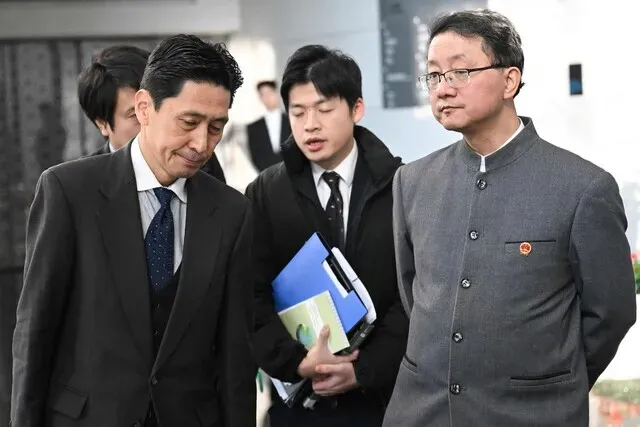
Masaaki Kanai (left), Japan’s high diplomat for Asia and the Pacific, departs from the Chinese language Ministry of International Affairs in Beijing on Nov. 18, 2025, after talks amid backlash from China over feedback by the Japanese prime minister. (AFP/Yonhap)
On Nov. 20, the Chinese language Embassy in Seoul posted a press release on its web site titled “Q&A with the spokesperson of the Chinese language Embassy about US officers’ unacceptable remarks.”
“We hope the US will do extra to learn the China-US, China-Korea and Korea-US relationships and never sow discord or choose a combat,” the assertion learn partly.
The assertion referred to remarks from Kevin Kim, the appearing US ambassador to South Korea, on the identical day relating to the unlawful installations China has been constructing within the Yellow Sea, which lies to the west of Korea.
“On the coronary heart of that stability within the Korean Peninsula and the Indo-Pacific area is our alliance, and everyone knows that our safety challenges are evolving each within the peninsula and the area,” Kim stated. “We should work collectively to deal with these widespread challenges. Look no additional than what has occurred within the Yellow Sea not too long ago,” Kim stated.
The embassy’s assertion was additionally referring to Caudle’s remarks.
China’s comparatively reticent response to South Korea’s pursuit of nuclear-powered submarines appears primarily as a consequence of the opportunity of the scenario altering. The difficulty is a long-term one, as it may take as much as 10 years to truly full the development and deployment of nuclear-powered submarines as soon as discussions start. Adjustments within the American political scenario, due to this fact, should not out of the query.
“At present, there doesn’t appear to be many concrete agreements between the US and South Korea relating to nuclear-powered submarines. Nuclear-powered submarines are a contentious difficulty, and it’s potential that there will likely be disagreements between South Korea and the US in the course of the course of main as much as South Korea constructing them,” commented an professional on Chinese language diplomacy who wished to stay nameless.
Beijing might also be cautious that if it responds too forcefully to the problem, it could solely push the US and South Korea nearer collectively.
There additionally seems to be the strategic consideration that now just isn’t the time to fire up battle with Seoul, contemplating Beijing’s ongoing spat with Tokyo over Japanese Prime Minister Sanae Takaichi’s remarks on Taiwan.
Sooner or later after Lee’s bilateral assembly with Trump on Oct. 29, the US president stated he had accepted South Korea’s building of nuclear-powered submarines. A day later, on Oct. 31, Takaichi held her summit with Chinese language President Xi Jinping in Gyeongju. The following day, Takaichi posted a photograph on the social media platform X of her assembly with Lin Hsin-i, a senior adviser to the Taiwan presidential workplace, sparking a confrontation between Japan and China.
Lower than every week later, on Nov. 7, throughout an inquiry on the Japanese Home of Representatives, Takaichi referred to the opportunity of Japan intervening militarily within the occasion of a Chinese language invasion of Taiwan, inflaming tensions between the 2 nations to their worst state in years.
Traditionally, China has exhibited a bent to undertake a harsh stance in direction of South Korea when relations with Japan are bettering. When relations with Japan are deteriorating, China tends to emphasise a typical battle towards Japanese imperialism to attraction to South Korea. At present, China appears to be focusing its diplomatic strain on Japan whereas strategically sustaining pleasant relations with South Korea.
Third, there are the teachings of THAAD. When South Korea accepted the deployment of the US Terminal Excessive-Altitude Space Protection anti-missile system on Korean soil in 2016, the retributive measures that China levied towards South Korea on the time are much like the full-frontal strain marketing campaign that China is at present waging towards Japan.
Chinese language vacationers kept away from going to South Korea, and the Chinese language state issued an unofficial ban on Korean leisure and content material. It additionally leaned on Korean corporations and poured diplomatic strain on the Korean authorities.
A Chinese language diplomat even publicly declared, “China is a superb nation, South Korea a minor one.” This resulted in a feverish rise in anti-China sentiment and hatred of China amongst Koreans. Such sentiment and hatred have since taken root within the Korean public. Even amongst Chinese language diplomats and overseas coverage specialists, there’s a tacit consensus that China’s response to THAAD harmed China’s nationwide pursuits and technique in the long run.
Fourth is South Korea’s constant messaging to China that the nuclear-powered submarines should not focusing on China however are in response to the specter of North Korea’s nuclear weapons. A authorities insider stated, “Via a number of diplomatic channels, together with the summit with China, we’ve constantly communicated to China that the nuclear-powered submarines are to counter the North Korean risk.”
“As we’ve no nuclear weapons, we’ve persistently defined that we would wish them if we’re to train deterrence to a point and that the transfer just isn’t focusing on China.”
Specialists say that the extra constant South Korea is on the problem with out devolving into infighting, the stronger South Korea’s diplomatic place in relation to China will likely be.
By Park Min-hee, senior workers author
Please direct questions or feedback to [english@hani.co.kr]
[ad_2]
